
Halfway to the Singularity

Exactly twenty years ago today, Ray Kurzweil predicted the technological singularity would arrive by 2045 — meaning we should now be halfway there. Are we?
After the death of the world-renowned mathematician John von Neumann, his friend and colleague Stanisław Ulam wrote a memoir for the journal of the American Mathematical Society. In it, he recalled a conversation they had about the ever-accelerating progress of technology, which, according to Neumann, foreshadowed the approach of a turning point “beyond which human affairs, as we know them, could not continue.”1
The essence of Neumann's observation is that the more advanced the technology available to humanity becomes, the faster it enables further development. Therefore, as we move forward in time, we can say not only that progress continues, but also that it continues at an increasingly rapid pace.2 If this is true, then the time will eventually come when the rate of technological advancement becomes so unimaginably fast, and its impact so widespread and profound, that it will fundamentally change humanity’s role, possibilities, and limitations in the world — this is the technological singularity.
Historical experience supports this observation: even if not consistently across all regions, overall, technology has become increasingly advanced from generation to generation, century to century. As a result, each new generation could start from a slightly higher technological level than its predecessors. Until quite recently, this process was so slow that it was imperceptible within an individual’s lifetime — until everything suddenly changed in the past two hundred years. However, for progress to accelerate indefinitely, this alone is not enough. Most of the time, taking the first steps is easier, continued advancement becomes increasingly difficult, requiring ever more knowledge and resources. The singularity can only occur if the pace at which technological capabilities accumulate consistently exceeds the pace at which difficulties increase.
Think exponential
Few have done more to popularise the idea of technological singularity than Ray Kurzweil. In his 2005 book The Singularity Is Near, published exactly twenty years ago today, he took examples from the fields of computing, artificial intelligence, nanotechnology, and biotechnology to support the claim that the singularity is not merely a distant vision, but a reality that could arrive within our lifetimes — by 2045.3
In spite of his successful business career, Kurzweil is primarily known for his bold long-term technological predictions that are concrete enough to be held accountable later. In late 2012, the community of LessWrong examined 172 of his claims made in 1999, which were supposed to come true within ten years.4 According to the volunteer reviewers, 42% of the claims turned out to be true, 46% false, and only the remaining 12% were too vague to assess. Considering that these statements weren’t ambiguous at all, but rather concrete (specific enough to even serve as the basis for business decisions),5 this is quite a remarkable achievement. In 2020, the same online community reviewed the predictions Kurzweil made in 1999 that were meant to come true within twenty years (i.e., by 2019): this time, only 24% of the 105 claims were found to be accurate, while 67% were deemed false.6 This marks a significant decline compared to the ten-year assessment and is not a particularly strong result. However, the analysis also revealed something else: many of the predictions for 2009 that had not come true by 2012 had, in fact, materialized by 2020. In other words, even when Kurzweil was wrong, he generally pointed in the right direction — only he was overly optimistic about the pace of change. How did he know? What is his secret?
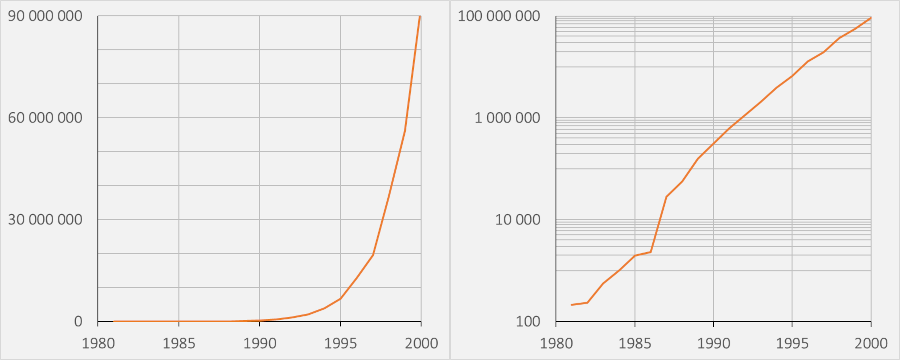
He tracks exponential growth. In order to see how the technologies of the future will grow out of those already surrounding us today, we need to shift our way of thinking. On a linear scale, certain technological innovations seem to emerge suddenly, while on a logarithmic scale, they are perfectly predictable. Take the example of the internet: in the chart on the left, we see that the number of computers connected to the internet began to grow explosively around 1993–94, seemingly out of nowhere, increasing nearly a hundredfold in just a few years. The second chart shows the same data, but with the number of computers plotted on a logarithmic scale, which is better suited to demonstrating exponential growth. This shows that the growth rate was predictable and consistent, increasing at nearly the same pace year after year (and if there was any surprise, it was a slight slowdown in 1986, not the steady growth in the mid-1990s). A similar pattern can be seen with many other technologies that Kurzweil discusses.
This also implies the limitations of his forecasts. No matter how good he is at predicting the direction of development, few trends maintain the same intensity for twenty years, so the further ahead he looks, the more inaccurate his predictions become. Secondly, although an authority in the field of computer science, he is not exceptionally skilled at estimating the social acceptance and impact of innovation — and is notoriously reluctant to admit when his predictions go wrong.7
We’ll be the Borg
Alright, but what happens by 2045 — what is it that brings about the singularity? Put most generally: the exponential growth of the performance-to-price ratio of computers drives progress in all other fields.8 According to Kurzweil’s 2005 prediction, by the mid-2040s, one thousand dollars’ worth of computation will reach 10²⁶ operations per second, so the machine computation capacity created per year will be one billion times more than the combined biological computation capacity of humanity.9 One can actually find an independent estimate that supports this: back in 2011, two researchers calculated the machine-based information processing capacity of humanity in 1986, 1993, 2000, and 2007. The growth was accelerating: while it was only 42-fold between 1986 and 1993, it was already 81-fold between 1993 and 2000, and 130-fold between 2000 and 2007.10 If we project this trend into the coming decades, we do in fact arrive at a scenario where by the mid-2040s the annually produced artificial computational capacity reaches 10³⁵ operations per second — if it made sense to extrapolate a trend observed between 1986 and 2007 into 2025–2045.11
Reality, however, cannot keep up with this: in 2023, the computing performance per thousand dollars was supposed to have been around 10¹⁶ operations per second, but even according to Kurzweil's own data collection, it fell short by two orders of magnitude.12 By 2045, perhaps the 10¹⁹ magnitude might be reached at most, but 10¹⁵–10¹⁶ is much more likely – it's no wonder that the sequel published last summer, The Singularity is Nearer, although it continues to focus on the exponential growth of the performance-to-price ratio, refrains from making quantified predictions.
It must be emphasized that, according to Kurzweil, it is not the increase in computational capacity itself, but rather the technological advancements enabled by it in other fields that result in the singularity. As for its tangible content, two well-defined, successive steps lead to technological singularity:
Artificial intelligence will reach human level by 2029, as evidenced by passing the Turing test. (This is not just some vague reference to the test: Kurzweil precisely defined the detailed rules as early as 2002.)13
A brain-computer interface with a few million to a few tens of millions of channels will enable merging with artificial intelligence by 2045, thereby turning artificial intelligence into an extension of consciousness.14
Regardless of whether we believe this would be beneficial, it is no doubt a rather concrete scenario, which would fundamentally alter human existence, thus fulfilling Neumann’s criterion. We could say that we do not want to become Borg, but it’s undeniable that being Borg is fundamentally different from being human.15 Moreover, while these two steps are challenging, neither can be dismissed as definitively impossible.
Time for the Roaring Thirties
But is it really true that technological development is accelerating? If we rely on our impressions, there is reason to be sceptical. Humanity's arguably greatest achievement so far, the Moon landing, has not been surpassed in more than half a century (and has only been repeated a few times). The speed of the fastest mode of transportation has remained virtually unchanged for 70 years, since the advent of jet-powered passenger aircraft. And if we exclude digital technologies, the world looks more or less the same as it did in the 1970s: by the end of that decade, three-quarters of American households had a colour TV and a washing machine, half had air conditioning, a dishwasher, and a dryer. Of the conveniences of modern life, only the microwave oven, spread in the 1980s, was missing.16
And what do the numbers show? As Nick Bostrom points out, a good measure of the overall pace of technological development is not the growth of a few selected leading sectors, but productivity as a whole, which encompasses all technological innovations (understood not only as machines and devices, but also procedures, processes, and institutions), weighted by their economic significance.17 In the world’s leading economy, the United States, productivity grew by 112 percent between 1950 (since when we have reliable data) and 1984, but only by 73 percent between 1985 and 2019 (a similarly 35-year period). The same trend appears when we compare the first and second halves of the last 30 years: between 1990 and 2004, growth was 36 percent, but only 18 percent between 2005 and 2019. No matter which two consecutive periods of equal length we compare, we consistently see that the pace of growth was higher in the first than in the second — if we were truly approaching the singularity, this trend would have to be the other way around.
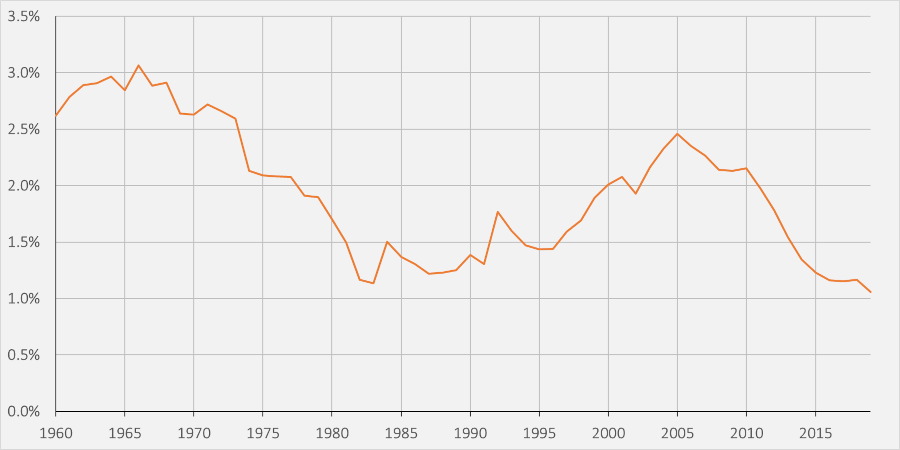
The change in the productivity rate shows that the pace of growth slowed from its peak in the 1960s to 1.2–1.3 percent annually by the 1980s, followed by a temporary strengthening lasting a decade and a half, after which it again declined to that level. This acceleration, which began in the second half of the 1990s, was due to digital technologies: the personal computer, the internet (and the online commerce built on it), and the mobile phone. But why is it that these undeniably transformative technologies had only a relatively moderate and time-limited impact on productivity? Robert Gordon wrote the following about this in 2012: “Attention in the past decade has focused not on labor-saving innovation, but rather on a succession of entertainment and communication devices that do the same things as we could do before, but now in smaller and more convenient packages. … These innovations were enthusiastically adopted, but they provided new opportunities for consumption on the job and in leisure hours rather than a continuation of the historical tradition of replacing human labor with machines.”18 This will hardly bring about the singularity.
Among proponents of the singularity hypothesis, a dominant (though not exclusive) idea is that it will be the creation of artificial intelligence reaching or surpassing human intellectual capabilities what triggers accelerated development.19 Even if the recursive self-improvement envisioned by Irving Good, Vernor Vinge, and their modern followers does not materialize, it is still reasonable to expect that the widespread application of machine intelligence could lead to significant productivity gains—since, unlike the “innovations” of the past two decades, this is a technology that is indeed capable of replacing human labour.20
According to a relatively conservative forecast by Goldman Sachs, artificial intelligence could increase productivity by a total of 16 to 33 percent over the course of one or two decades—already much more than the 9 percent boost attributed to the spread of digital technologies.21 McKinsey estimates that this growth could be considerably greater, potentially reaching 3.5 to 4 percent annually, which would amount to a doubling over two decades.22 Robin Hanson goes even further, suggesting that we could be on the brink of a transformation as profound as the agricultural revolution 5,000 years ago or the industrial revolution around 1800: not just an increase in productivity, but our whole economy entering a new, steeper growth trajectory.23 Even if the singularity does not occur, we may yet be approaching a period of expansion unmatched since humanity’s most dynamic decade to date, the 1960s.
Regardless of the direction and pace of technological development in the 21st century, one thing is certain: those who turn singularity into a religion are bound to be disappointed — it will bring them neither judgment day, nor the afterlife, nor salvation from their current existence. On the other hand, it is also untenable for someone to accept the theoretical possibility of the technological singularity occurring at some point, while simultaneously rejecting from the outset any contemplation of technologies such as mind uploading (the transfer of human consciousness to a computer) or superhuman machine intelligence — the very definition of the singularity, according to von Neumann, is that it fundamentally transforms human existence.
As Nick Bostrom aptly notes, if by progress we mean that things are getting better, it is far from self-evident that the unfolding of technological capabilities constitutes progress, even if that has typically been the case in the past. This is an important distinction, however, for the sake of simplicity, I use “progress” as a synonym for technological advancement. Bostrom, Nick (2007): The Future of Humanity, Technology, growth, and directionality
Kurzweil, Ray (2005): The Singularity is Near: When Humans Transcend Biology
Some examples: “most purchases of books, musical albums, videos, games, and other forms of software do not involve any physical object, so new business models for distributing these forms of information emerge”; “computer memories that use a rotating platten, such as hard drives, CD-ROMs, and DVDs are on their way out”; “the virtually constant use of electronic communication technologies is leaving a highly detailed trail of every person's every move”.
Kurzweil, Ray (2024): The Singularity is Nearer: When We Merge with AI, Introduction
Since Kurzweil consistently estimates the brain's computation capacity at 10¹⁶ operations per second, this corresponds to 10³⁵ calculations per second. Why he considers the one-billion-fold amount a milestone — as opposed to, say, the million-fold or the trillion-fold — he does not explain. The Singularity is Near, pp. 135–136, Setting a Date for the Singularity. See also the calculations in the appendix, p. 494
Hilbert, Martin–López, Priscila (2011): The World’s Technological Capacity to Store, Communicate, and Compute Information, Table S A-3
Hilbert and López refer to total stock, whereas Kurzweil considers annual production; this is, however, not a significant difference, since computing capacity multiplies each year by the end of the period.
Kurzweil provides detailed data on the all-time leaders in performance-to-price ratio – from Konrad Zuse’s Z2 in 1939 to the Google TPU v5e in 2023 – in the appendix of The Singularity is Nearer.
Kapor, Mitchell – Kurzweil, Ray: By 2029 No Computer – or "Machine Intelligence" – Will Have Passed the Turing Test
The Singularity is Nearer, pp. 69-73, Extending the Neocortex into the Cloud
The Borg are an extraterrestrial civilization of cyborgs linked into a hive mind in the Star Trek universe.
Our World in Data (2019): Share of United States Households Using Specific Technologies. However, change is clearly visible in the less affluent regions of the world: in 1990, 44 percent of the global population lived in extreme poverty — on an income of less than about three dollars a day — while today that figure is 10 percent. Between 1980 and 2022, per capita production measured in purchasing power parity increased by 130 percent worldwide, by 195 percent in the Middle East, and by 340 percent in Southeast Asia. Our World in Data (2025): Share of Population Living in Extreme Poverty; Our World in Data (2024): GDP per Capita
Bostrom, Nick (2007): The Future of Humanity, Posthumanity
Another technology in the near future that enables significant automation will be humanoid robots.